
Predictive Maintenance Records
All predictive maintenance must count on a record, not only a report’s record but also a record of the maintenance tasks that are performed on the assets. A good predictive maintenance management considers not only the documentation of the predictive inspection reports but also that of all the maintenance events of every asset.
Predictive maintenance events
The type of interventions that must be informed to the predictive maintenance analysts are:
-
Corrective
shafts alignments, seals replacement, balancing.
El historial de mantenimiento predictivo
Todo mantenimiento predictivo debe contar con un historial no sólo de informes sino también de las tareas de mantenimiento que se realizan en los activos. Una buena gestión del mantenimiento predictivo no solamente contempla la documentación de los informes de inspecciones predictivas, sino también la de todos los eventos de mantenimiento sobre cada activo.
Las intervenciones de mantenimiento predictivo
Los tipos de intervenciones que se deben informar a los analistas de mantenimiento predictivo son:
Types of Predictive Reports
As a vibrations analyst, I made the mistake of sending the same type of report to all my clients irrespective of the context in which I was performing the analysis. If I had known what I’m about to tell you, I would have saved a lot of time.
There are two types of predictive maintenance reports:
Tipos de informes de predictivo
Como analista de vibraciones cometí el error de enviar el mismo tipo de reporte a todos mis clientes indistintamente del contexto en que hacía el análisis. Si hubiera sabido lo que te voy a decir, hubiera ahorrado mucho tiempo.
Hay dos tipos de informes de mantenimiento predictivo:
Nuevo menú contextual en el árbol de jerarquía de activos
Power-MI lanza nueva función de menú contextual en el árbol de jerarquía. Al hacer click derecho sobre activos en espacio de trabajo, jerarquía o árbol de activos
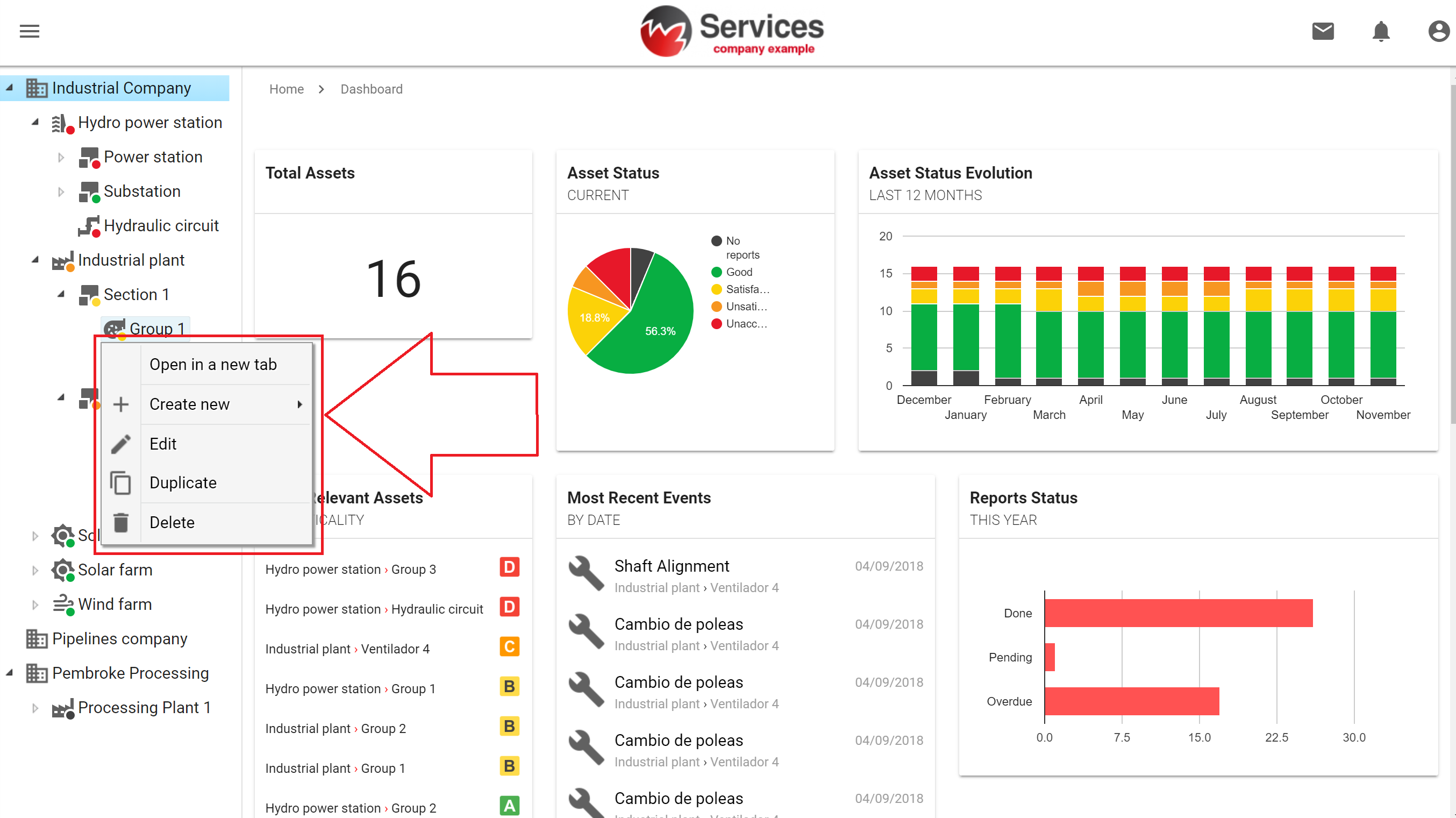
Esta nueva función permitirá a los usuarios de Power-MI gestionar de forma más cómoda el espacio de trabajo ya sea cuando se crean activos por primera vez como cuando se desean hacer cambios en un espacio de trabajo ya hecho.
New Asset Hierarchy Tree Contextual Menu
Power-MI launches new contextual menu function on the hierarchy tree. By right clicking on assets in workspace, hierarchy or asset tree.
This new feature will allow Power-MI users to more comfortably manage the workspace either when creating assets for the first time or when they want to make changes in a workspace already done.
Sensores de vibración MEMS
¿Qué es un sensor MEMS?
El término MEMS se refiere a micro-sistemas electro-mecánicos o micro-electro-mechanical systems por sus siglas en inglés. Es decir, los MEMS son sistemas que se fabrican con componentes que tienen un tamaño de entre 1 a 100 micrómetros, y que alcanzan un tamaño promedio total de 20 micrómetros a 1 mm. Para fabricarlos se utiliza lo que se conoce como obleas de silicio, tal y como se fabrican los circuitos integrados.
MEMS Vibration Sensors
What is the MEMS sensor?
The term MEMS refers to micro-electro-mechanical systems. This means that MEMS are systems with components as small as 1 to 100 microns in size, and these systems can reach an average size of 20 microns to 1 millimeter. Like any integrated circuit, MEMS are manufactured with what is known as silicon wafers.
Power-MI lanza Manual de análisis de vibraciones
Power-MI lanzó su primera edición del “Manual de análisis de vibraciones”, un resumen de los conceptos básicos que todo analista de vibraciones necesita saber.
El manual contiene 86 páginas de contenido técnico y tiene como finalidad ser un apoyo al analista de vibraciones para entender los conceptos de mantenimiento predictivo en el entorno industrial, mejorar su capacidad de diagnóstico en problemas de maquinaria y servir de referencia cuando el analista realiza sus informes de análisis de vibraciones.
Criticality Analysis of Industrial Assets
One of the first tasks at the moment of implementing or optimizing predictive maintenance is analyzing the criticality of industrial assets, whether they are machines, static equipment, distribution systems or electrical panels. By using the criticality analysis, we can prioritize those assets that require the highest level of monitoring and where the predictive maintenance can have the highest impact.
Criticality is mathematically defined as follows:
`sf "Criticality" = sf "Probability of failure" xx sf "Consequence of failure"`